
The Scriptures teach that following Jesus includes a prophetic dimension, which lifts up a vision of social well-being. This means Christians are to act in civic life for the benefit of the neighbor, especially our marginalized or oppressed neighbors. We should evaluate actions and policies according to whether they best serve the needs of these neighbors as a guide to determining the common good.
—ELCA Statement on Faith and Civic Life, Article 16
Dear friends,
I know that many of you are invested in the upcoming midterm elections in the United States. You have made your plan to vote and talked to your loved ones about doing the same. You have donated money or volunteered at the polls. You have canvassed or phone banked for candidates you care about. You have educated and organized your communities for the common good.
For many of us, this is a time of increased anxiety. Our hopes and fears for the world are top of mind. Democracy in the United States already feels fragile for so many reasons: partisan gerrymandering, money in politics, ideological polarization, just to name a few. Will our democracy survive ongoing corruption and voter suppression? What will the outcome of this election be, and what will that mean for our collective future?
In these anxieties, we are not alone; we find ourselves in the good company of our ancestors in the faith. Our faith tradition arises from oppressed people, living in times of political upheaval, fearing for their futures. In your questions, I hear echoes of the prophets: How long will our hearts break at the pain of this world? Will justice ever be possible? In your concerns, I see a reflection of God’s concern for the earth and all her creatures. In your faithful actions, I see the body of Christ, drawing near to heal, to lift up, to feed, to empower.
The promise of our faith in times like these is that the future belongs to God. By “the future belongs to God” I don’t mean that we should throw up our hands or abandon responsibility towards the future. I mean that we can trust that God’s salvation extends beyond the limits of our best efforts. God’s promise remains sturdy even when human systems fail. God’s future is ours even if we can’t imagine it in our lifetimes.
As all these events unfold in our political realm, worship in November will focus on the Merciful Reign of Christ. Called “the day of the LORD” in the Hebrew Bible, or “the kingdom of heaven” in the gospels—we are talking about God’s promised future, in which God will set all things right: banishing evil, bringing justice, healing what is broken, and restoring peace. Lutherans proclaim that this future is both “already” and “not yet.” The Reign of Christ has already begun to come forward to meet us in the present. Most importantly, God promises a relationship with us that never ends.
And so, we participate in US politics as faithfully as we can, and with utmost concern for our neighbors. Meanwhile we orient our attention—and our whole lives—towards the politics of Christ, in which the lowly are blessed, the poor are lifted up, the powerful are cast down, abundance is shared, the hurting are healed, the outcast find a place. The politics of Christ transcend every earthly empire, cannot be defeated by human violence, and defy even death itself. This is the basis of our hope.
In Christ,
Pastor Erin
Protect the Vote Team
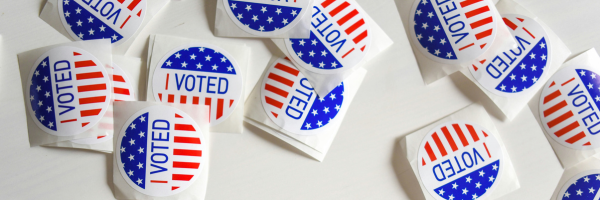
Several members and friends of St. Luke’s are part of the Metropolitan Chicago Synod’s Protect the Vote Team, which provides resources for congregations to engage in the upcoming midterm elections. They assembled a Metro Chicago Synod Election Prep Toolkit which shares ideas for engagement that could work for a variety of different contexts and levels of time commitment. Check out the toolkit here!
Protect the Vote Team members: Pastor Elle Dowd, Pastor Monte Johnson, Pastor Adam Dowd, Marcia Smith, Pastor Anne McCall, Pastor Nicolette Faison, Jennifer DeLeon, Em Jacoby, Vicar Hannah Peterson, Pastor Larry Clark.